Table
of Contents (click any topic to view)
Topic
1 What Is a Unit Study? Pick a Topic, Any Topic!
Topic
2 Pick an Interest, Any Interest
Topic 3
How Do You and Your Children Learn Best?
Topic
4 Special Needs: Unit Studies, Special Needs and Labeled
Children
Topic 5 Homeschooling Teens,
Homeschool High School, Homeschooling College and Distance
Education
Topic 6 Links for Special Needs,
Giftedness, Unit Studies
Topic 1 What Is a Unit Study? Pick a Topic, Any Topic!
Homeschoolers, like all
educators, can fall into the easy trap of spouting educational jargon
until it becomes almost meaningless, especially to newcomers. We
forget, perhaps, that everyone was once a newbie!
The term "unit
studies" is an especially slippery fish of a term, because it
can mean so many things. It may refer to a relaxed, interest led
frolic through a subject, initiated by a child's interest in, for
instance, cars. The child reads about cars, draws cars, examines the
insides of cars, takes cars apart, measures cars, studies the math
and science of cars, bakes and eats car shaped cakes, and builds a
model car.
The opposite extreme may be the child homeschooled
with a traditional approach. The child's parents pick a unit study
out of a book, or perhaps buy a unit study curriculum. The publisher
supplies or suggests the materials, and the parent (as teacher) sits
with the child, going progressively through the planned unit study.
Most often, homeschool families fall somewhere in between these two
examples.
Whatever your methods, a unit study will mean
researching a specific topic intensively, and attempting to "cover
all the bases" of subjects required by your curriculum. For
instance, in the car unit study, your child can practice and learn
math (car maintenance records, cost of repairs, etc.), language arts
(collecting and reading manuals and car magazines), social studies
(different cars of the world), music (songs about cars), and so on.
Cars would be a particularly difficult subject for me to teach,
as I am singularly helpless around anything mechanical. Children have
a way of becoming interested in subjects that their parents (and
other teachers) know nothing about. (Imagine that!) That's one reason
you will see my interest-led learning bias crop up so often.
Motivated kids can learn anything, whether the adults teach them or
not.
One daughter loved dance, and I trip over my own feet. But
we borrowed videos and enrolled in community ballet classes. My main
job is to help my kids find the resources (books, courses and
computer programs) and mentors (knowledgeable teens and adults). I
may not know everything about everything, but I can learn about
resources, and how to find them economically. And you can too.
Topic 2 Pick an Interest, Any Interest
You may decide to choose
unit study topics for your children; if you do, may I suggest you
give them a choice of several? If they make the final decision, they
will show more interest and excitement in the project.
Or you
could ask your children to make lists of ideas to explore. You could
also brainstorm along with them. What have you, parents, always
wanted to learn? If you love learning, you will model lifetime
learning skills, giving your youngsters an example to follow.
Finally, pick an interest, any interest. Don't worry if it isn't
the unit study to end all unit studies. There are plenty more where
that came from! (Also see topic 6 Start Your
Unit Studies for resources.)
Topic 3 How Do You and Your Children Learn Best?
You've probably heard
educators talk about learning styles. Your learning style just
means how you learn best. You may be a visual learner (looker), an
auditory learner (hearer) or a kinesthetic learner (doer). You (and
your children) may also be a combination of all three learning
styles.
Perhaps you are just looking for ways to help your
children with school homework. Or you may be a veteran homeschooler
of fifteen years, with ten children (If so, please share your
knowledge with us!) Either way, the more you understand about the
learning style of each individual in your family, the easier it will
be to learn together!
Lookers and hearers sometimes have trouble
working with their hands. They can learn better when they strengthen
all their senses. Hearers can jump rope in time to a multiplication
video. Visual learners can explore real world math.
Doers can
practice their sight skills, perhaps through the use of a computer.
Doers can also learn quickly through educational software and apps.
If your child struggles with learning in a traditional way, find
another way. Doers may hate handwriting, but tolerate typing on a
keyboard.
Most people use several or all the senses to learn,
although they may be stronger in one area. It’s funny how you
seldom hear much about smell and taste, the neglected senses for
learning. Explore all your senses. The Bible says, “Taste and
see that the Lord is good.”
Topic 4 Unit Studies, Special Needs and Labeled Children
Of course I haven’t walked a mile in your
shoes, but I can relate somewhat to parenting a child with special
needs. Our youngest spent her first months in the hospital. She
started out not breathing, and with low vision. Within her first year
of life, she was given several diagnoses of rare syndromes. If you
are also parenting a child with challenges, you might enjoy my column
on Special Needs Preschool in the January 2005 edition of Mary
Pride's Practical Homeschooling
magazine. Also check
out Mary Pride's list of Homeschooling support groups at Homeschool
World.
Requirements
vary by state and sometimes also by district, but it is legal to
homeschool your child with special needs. Get in touch with your
state homeschool organization, also HSLDA (Home School Legal Defense
Assoc.) and NATHHAN (which is the national org. for homeschoolers
with special needs), http://www.nathhan.com/.
It is important to network with others who homeschool in your area.
Homeschooling
with special needs is a challenge. However, I often hear from friends
with kids in school programs; they also suffer many
difficulties. Through the grace of the Lord and the guidance of
many, many faithful friends and family members, we're able to
homeschool with special needs, a day at a time.
Homeschooling Attracts
Families With Special Needs
I'm still
surprised by the number of parents consulting me
for information to help a child diagnosed with autism, ADHD
(Attention Deficit Hyperactivity Disorder) or learning disabilities.
(This frequent interaction was the primary reason I wrote this page.)
Homeschooling will naturally attract (and always has) families
with unique children, as the institutional schools are set up more
for conformity than non-conformity. In this regard, the "learning
disabled" child and the "gifted child" share much in
common. If you have studied strategies for teaching both groups, you
may discover striking similarities. So even if you don't have a
labeled child, you may find some great learning tools by checking out
some of these resources!
Although controversial, many parents
find that alternative health approaches, such as nutritional therapy,
can be quite effective in the treatment of ASD (Autism Spectrum
Disorder), ADD, ADHD, apraxia and hyperactivity.There is
speculation now that one cause of the increased incidence of autism, ADHD and communication
disorders such as apraxia could be EFA (essential fatty acid)
deficiency. Studies are currently underway. In America, EFAs are only
now beginning to be added to infant formulas, while I understand they
have been included in formulas in United Kingdom for some time.
Recently parents also report that adding amino acids, specifically
L-Carnosine, have helped their children's speech.
Here are some
web sites that talk about EFAs:
CHERAB Foundation Communication
Help, Education, Research, Apraxia Base http://www.cherab.org
http://groups.yahoo.com/group/childrensapraxianet
Speechville, http://www.speechville.com
See Topic 6 Start Your Unit Studies for
more resources. For more information on health, visit A
Wise Steward's Health page
The
Good News About Homeschooling a Child With Special Needs
Although there is a high number of homeschooled
children with learning differences, homeschoolers consistently score
higher than average overall on standardized tests. I expect this
trend to continue. In addition, studies show that in homeschools,
income and the parent's level of education make no appreciable
difference in test scores.
If your children have never been to
school, and you have trained them in self-directed, interest-led
learning, by around third grade they may be able to take over much of
the responsibility for their own education. Your job will be to
watch, guide, answer questions, help obtain needed supplies, and
occasionally prod (encourage and discipline) a bit. You may already
be very familiar with unit studies, or if not, you may soon realize
that your children have been doing unit studies all along, without
realizing it. As young people approach adulthood, the transition to
college or career can be a natural progression from interests and
unit studies.
If your child has attended school extensively, or
if you have a school-like atmosphere at home, you may find that you
need to constantly keep the child "on task." Some parents
feel the necessity of even sitting with a teenager six hours a day,
as a tutor. If this is the case, and you don't mind, then why worry?
If you fear insanity and burnout--and perhaps wonder if you'll still
be sitting like this when your young adult turns thirty-- don't
despair. There is no better time than the present, and no better way
to train for adult responsibilities than a unit study.
Everyone
is gifted, in some area. God makes people different for a reason.
Thomas Edison's schoolmaster called the seven year old inventor-to-be
"addled." Edison's mother removed her son from school after
only three months, and taught him at home. The trick is to find out
what your child likes best, and then incorporate it into his
education.
Unit studies can be the open door for a labeled
child. Your family may enjoy a unit study on famous homeschoolers,
such as Thomas Edison. Here are a few more, to get you started:
Alexander Graham Bell, Agatha Christie, Albert Einstein (he taught
himself calculus, and other abstract subjects), Wolfgang Mozart, Mark
Twain, George Washington. Many items can be borrowed through
inter-library loan; it’s worth a try to ask your local
librarian.
Hint: Try mixing special needs resources up. Use some
of the techniques for Kids labeled learning disabled to teach your
gifted preschooler. Try some of the gifted programs on your learning
disabled child. In my opinion, all kids are gifted by God;yet we all
also have our limitations.
General Special Needs Resources:
NATHHAN, P.O. Box 39, Porthill, Idaho, 83853, 208-267-6246; http://www.nathhan.com/ , North American support group for homeschoolers with special needs.
http://www.songsoflove.org , offers free personalized songs for seriously ill children.
ADD and ADHD at Verywell, Verywell
Woodbine House, special needs books, http://www.woodbinehouse.com
Communicating Partners, James MacDonald's unique family-friendly speech program, http://www.jamesdmacdonald.org
RJ Cooper and Associates, 24843 Del Prado #283, Dana Point, CA, 92629, 800-RJCooper, http://www.rjcooper.com ; computer, electronic, digital resources for children with challenges
Curriculum Associates, (800)225-0248; "Customize Your Own Curriculum", special needs testing and resources, http://www.curriculumassociates.com
Enabling Devices, toys and handy gadgets for kids with special needs, http://enablingdevices.com
Recording For the Blind and Dyslexic/Learning Ally, http://www.learningally.org , 20 Rozel Rd.,Princeton, N.J., 08540, 800-221-4792, textbooks on tape, all grades, includes ABeka and Bob Jones curriculum.
Enabling Devices, http://www.enablingdevices.com , toys for special needs children.
Christian Cottage Schools, 3560 West Dawson Rd., Sedalia, CO, 80135, 303-688-6626, http://www.christiancottage.com ,diagnostic testing and curriculum recommendations.
FEAT (Families for Early Autism Treatment), http://www.feat.org , non-profit networking organization parents and professionals, designed to help families with children who have received the diagnosis of Autism or Pervasive Developmental Disorder (PDD NOS).
Easter Seals, www.easter-seals.org , services help children and adults with disabilities gain greater independence--400 centers nationwide.
Considering ABA (Applied Behavior Analysis? Free ABA downloads at abaresources.com
Dr. Greenspan, creator of Floortime, http://www.stanleygreenspan.com/
Son-Rise Program®, for children and adults challenged by Autism, Autism Spectrum Disorders, Pervasive Developmental Disorder (PDD), and all other developmental difficulties how to design and implement home-based/child-centered programs enabling their children to dramatically improve in all areas of learning, development, communication and skill acquisition, http://www.son-rise.org/
TEACCH, another program for autism spectrum Disorders and communication challenges, http://www.teacch.com/
Sensory Integration information from Autism site, "...sensory integrative dysfunction is a disorder in which sensory input is not integrated or organized appropriately in the brain and may produce varying degrees of problems in development, information processing, and behavior." Sensory Smart Child
Yahoo Group on Sensory Integration, http://health.groups.yahoo.com/group/sid_dsi/
Wordfinding Difficulties, http://www.wordfinding.com/ , help for communication challenges
Rhyme Zone (use for writing help, word retrieval, vocabulary development), http://www.rhymezone.com
Speechville Express, http://www.speech-express.com/
Handwriting Without Tears, http://www.hwtears.com/ , handwriting program written by an occupational therapist
FastForWord, http://www.fastforword.com/ , computer software for auditory processing, language and reading challenges
Vision Therapy information from autism site, http://www.autism.org/visual.html
Vision Therapy information, http://www.visionhelp.com/autism.htm "Too often, visual problems which would have been detected early in non-disabled children go undiagnosed and untreated for children with disabilities, perhaps because the visual examination would be difficult, or the child is not able to verbalize a problem, or the school's test showed "normal" 20/20 eyesight."
Vision Therapy, http://www.visiontherapy.org , "Vision therapy -- a type of physical therapy for the eyes and brain -- is a highly effective non-surgical treatment for many common visual problems such as lazy eye, crossed eyes, double vision, convergence insufficiency and some reading and learning disabilities. Many patients who have been told, "it's too late," or "you'll have to learn to live with it" have benefited from vision therapy."
Dana's View, http://www.danasview.net/index.htm , very comprehensive, special needs links
Home School Legal Defense Association, http://www.hslda.org/ , Legal issues involving homeschooling
Homeschool Support Group Lists, http://www.home-school.com/groups/ , from Practical Homeschooling magazine's web site
Uniquely Gifted, http://www.uniquelygifted.org , special needs and gifted information
Wrightslaw. special education news and legal advocacy. P. O. Box 1008, Deltaville, VA 23043, 804-257-0857, http://www.wrightslaw.com
Toilet Training Made Semi-Easy (by father of son with DS) http://www.ds-health.com/train.htm
Toilet-training time doesn't have to be stressful http://tinkletoonz.com/news.htm
An Eagle's Nest Homeschool, educational resources page (includes special needs resources), http://www.eaglesnesthome.com/sources.htm
Music and Listening Therapy Websites
Audiblox: Resource for Dyslexia and other Learning Difficulties, http://www.audiblox2000.com , system of cognitive exercises, aimed at the development of the skills foundational to reading, spelling, writing, and math. A resource for dyslexia, dysgraphia, dyspraxia, and other learning difficulties.
The Georgiana Institute website, non profit organization devoted to educating the public about Auditory Integration Training (AIT) http://www.georgianainstitute.org/
Music Therapy Makes A Difference, American Music Therapy Association, http://www.musictherapy.org/
AOSA Web Site: The American Orff-Schulwerk Association is a professional organization of music and movement educators dedicated to the creative teaching approach developed by Carl Orff and Gunild Keetman. We are joined by our belief that learning about music - learning to sing and play, to hear and understand, to move and create - should be an active and joyful experience. http://www.aosa.org/
THE SPECTRUM CENTER: Integrated Therapy Solutions, address questions such as laterality, crossing midline, body map, speech, attentiveness, dyspraxia, assertiveness etc. http://www.dyspraxia.net/
Center for Biomedical Research in Music: Auditory motor and cognitive neuroscience neurologic rehabilitation. Rhythm perception, rhythm production, and rhythmic synchronization. Neuroscience of music and scientific foundation of music therapy. http://www.colostate.edu/depts/cbrm/
Open Ear Center (OEC) Open Ear Center
Interactive Metronome http://www.interactivemetronome.com/
Sonas Healing Sounds: Concept of Syn-Energy Sonas & Samonas Sound Therapy http://www.samonas.com/ Vital Sounds: http://www.vitalsounds.com/
The Tomatis Method builds strong listening skills through auditory stimulation, to improve learning and language abilities, communication, creativity, and social behavior. http://www.tomatis.com/
EASe: Vision Audio Inc. provides the EASe (Electronic Auditory Stimulation effect) Compact Disc to ease the pain of hyperacusis and auditory hypersenstivity and provide a low cost alternative to auditory integration therapy or training. https://vision-play.com/
ABT: Advanced Brain Technologies is the creator of innovative brain-based products and technologies for therapeutic, educational and self- improvement benefits. http://www.advancedbrain.com/
Healing HealthCare Systems http://www.healinghealth.com/
Listening Fitness Programs. http://www.Listeningfitness.com/
Giftedness Education:
Accelerated Learning for Gifted Students
A
child may have learning challenges, but also giftedness--a twice
exceptional (2e) student. How can parents and teachers help?
A Nation Deceived and A Nation Empowered How Schools Hold Back America's Brightest Students
Davidson Institute for Talent Development - providing opportunities, nuturing, and support to gifted young people to develop their talents in positive ways.
Duke University Talent Identification Program - program which identifies academic talent in children and teenagers. Benefits include summer programs, publications, advanced classes, networking and support.
Education Program for Gifted Youth - The Education Program for Gifted Youth (EPGY) is a continuing project at Stanford University offering computer-based courses in mathematics and the mathematical sciences for bright young students through the Stanford Continuing Studies Program.
Eldorado-Emerson School - education for gifted students. Offers courses in arts, music, and foreign languages.
Gifted and Talented Education Resources
Gifted Child Society - a nonprofit organization that sponsors activities designed to help gifted children, their families and educators.
Gifted Children - online newsletter and networking forum for parents and teachers of children with special talents and abilities.
GT World - support community for parents of gifted and talented children.
Helping Your Highly Gifted Child - by Stephanie Tolan.
Hoagies' Gifted Education Page - excellent resource guide for the education of gifted children.
Institute for Educational Advancement - provides direct student services and education consulting. Also develops products to promote intellectual and creative growth for gifted youth.
National Association for Gifted Children (England) - works with talented and able children in England, Wales and Northern Ireland.
National Foundation for Gifted and Creative Children - a nonprofit foundation which provides free information and guidance to parents and educators of gifted and creative children.
Purdue University - Gifted Education Resource Institute - providing services to g/t students and their families, and graduate level training opportunities.
Study of Exceptional Talent - Advises and nurtures exceptional academic talent.
Summer Institute for the Gifted
Talented and Gifted Bibliography - resources about the lives and education of children identified as gifted and talented.
U.S. State Gifted Associations - directory of gifted associations across the USA.
University of Arizona DISCOVER Project - information on research in gifted education assessment. Contains project overview, publications, and a list of researchers and staff.
University of Connecticut: Neag Center for Gifted Education and Talent Development - houses the National Research Center on the Gifted and Talented, the Mentor Connection, the three summers master's program, and confratute.
University of New South Wales - Gifted Education Research, Resource, and Information Centre
Westside Charter School For The Highly Gifted - working to initiate the infrastructure required to develop highly gifted children.
Topic 5 Unit
Studies, Homeschooling Teens, Homeschool High School, Homeschooling
College, Distance Education
Homeschool High School and College
Perhaps you are just
considering unit studies and homeschooling. Or maybe your youngster has
always been homeschooled. Either way, most parents express concerns.
"Will my child's homeschooling be accepted as a "real
education?" Or will my child be considered a misfit, a drop
out?" What happens when my child becomes a teen? And of course
the big “C” question, “What about college?”
Yes, what about college? Studies show an alarmingly liberal bias
at America’s universities—and an agenda to change the
hearts and minds of Christian youth against the hearts of their
fathers. See books such as Brainwashed: How
Universities Indoctrinate America’s Youth
and Freefall of the American University.
All the more reason to consider Homeschooling college, and credit
by examination. You can save money and time. You can also explore a wide range of viewpoints and pick your choice of
textbooks. Find textbook reviews through Educational
Research Analysts (http://www.textbookreviews.org) and the Textbook League (http://www.textbookleague.org).
If your child is twelve years old or
younger, it is not too early to think about college. The good news is
that many universities view homeschoolers in a positive light. The
proof is in the pudding, so to speak, and homeschoolers that paved
the way did well academically and socially--better than their peers.
I recommend Cafi Cohen's book, "And What About College."
There is a link to it (as well as a section of resources for
homeschooling teens) from my "Books" section and Links page
at A Wise Steward's
Homeschool. In addition, the National Home Education Research Inst., at
http://www.nheri.org/ and https://homeschoolingforcollegecredit.com offer information that you may find helpful.
Most homeschoolers really don't need to go the GED route, unless they
want to. According to the Office of the General Counsel, the
Department of Education, students who have graduated from home
education are free of compulsory attendance, regardless of age. In
addition, home educated students (if not considered truant by the
state) can "self certify"--meaning that no third party
verification is required. To find out more, contact
http://www.hslda.org.
Many
colleges have accepted transcripts prepared by homeschool parents.
Dr. Inge Cannon's web site, http://www.edplus.com
includes information on creating transcripts and issuing high school
diplomas. Also check out http://www.boxfreeconcepts.com/edserv/, http://www.homeschooldiplomas.com and http://shop.jostens.com/
for transcript and diploma templates.
If you like homeschooling, you
might love homeschooling college. Check into non-traditional methods
for reducing college costs and graduating early. Look into ways
students have received college credit for life experience such as
extensive unit studies, portfolio evaluations, internships, travel,
and ministry work. For information on credit for prior learning and
life experience credit, check out http://www.collegeispossible.org/
. Teaching Home magazine
has an excellent article on homeschooling college, at
http://www.theteachinghome.com/newsletters/vol_2-no_83.cfm
.
Many homeschoolers use the portfolio assessment method to
evaluate their youngsters; did you know that you can also receive
college credit through the same method? Read Earn
College Credit for What You Know, by Lois
Lamdin, to find out more. Get it from The Council for Adult &
Experiential Learning, or through the inter-library loan program at
your local library.
All Education Schools (http://www.alleducationschools.com
) is a complete online guide to education programs and careers. Use
this site to search for schools by location, program type, or
specialty, then read detailed fact sheets on featured schools of
education, and contact admissions officers by requesting information.
Contact colleges that interest you, and ask about their requirements.
Visit the college web site for information. Also visit the Baker’s
Guide to Christian Distance Education, at
http://bakersguide.gospelcom.net/
.
Some colleges require SAT or ACT testing. If you wish, you can
find many resources to help study for these tests. Check into the
requirements for several colleges that you are interested in. Also
consider any possible scholarships that may require SAT or ACT
testing. Neither the SAT or ACT was necessary in our son’s case
as he already had accumulated credit by examination (through CLEP and
DANTES) before enrollment. Realistically, students will be limited in
the amount of time they can devote to studying for tests. We made the
decision to spend the time accumulating college credit, instead of
studying for college entrance exams. Many colleges with open
enrollment and consider students “adults”—regardless
of age--if they already have some college credit.
Find a free
search program to locate scholarships for college at
http://www.fastweb.com ,
Student Services
.Visit the Financial Aid Information
Page. Check out College
Board's Web site. Children of federal and military personnel can
find out about the Federal Children's Scholarship Fund at
http://www.feea.org/ . For
information on college loans and taxes, visit Ed.gov
.
Find career resources at Careernet,
Monster Board job postings and
CareerPath (want ads from major
newspapers).
Contact the U.S. Dept. of Education's toll-free
number, (1-800-433-3243) for information about Federal student aid
programs, or write to the Federal
Student Aid Information Center, P.O. Box 84, Washington, D.C.,
20044, for the free booklet, Funding Your Education. Try
Christianbooks.com for new educational books, videos, music CDs,
bargain priced!
Also find student
discount and textbook information at http://www.studentadvantage.com
and http://www.campusbooks.com.
Revolutionary
New College Options—Free University Level Courses
Homeschool
students who enjoyed unit studies may wish to explore new
project-based college credit options, called “competency
based,”which offer flexibility and a hands-on approach to
achieving an accredited college degree. Find out more through
University of Wisconsin (https://flex.wisconsin.edu/faqs/),
which has been a trail-blazer in this new education option. Other
university systems are also developing and testing new competency
based plans.
Try Coursera (https://www.coursera.org
) and Edx for a variety of free college online courses from Johns
Hopkins, UM, Stanford, UCSan Diego, Duke, MIT, Harvard,
U-California-Berkley, U-Texas, and more. Some Coursera classes may
require fees to access all material, which may be financial aid
eligible; check with your educational institution to see if classes
will receive transfer credit or not. Learn how some fee-based courses
may be credit-eligible, at https://www.edx.org/credit.
HippoCampus offers free videos in a variety of subject areas,
including mathematics. Courses range from arithmetic to calculus and
advanced math. Also consider options at Carnegie
Mellon University's Open Learning Initiative (http://oli.cmu.edu
), Saylor Academy and free
economics courses through Marginal
Revolution University (George Mason Univ.).
Learn about the
Alternative Credit Project Ecosystem, which is “a pool of
low-cost or no-cost, lower division courses and general education
online courses across 20 to 30 subject areas. Participating colleges
and universities agree to accept transfer credit for these courses,
allowing students to enroll with up to two years of credit toward a
four-year degree." (American
Council on Education, College Credit Recommendation Service)
Straighter
Line includes some ACE accredited courses, but requires a
relatively inexpensive membership fee (currently $99/monthly). Staighter Line offers
free trial lessons, http://www.straighterline.com/landing/take-free-trial-course-cnt.
ALEKS, another online course provider, also has a free trial course
available (https://www.aleks.com/free_trial/consumer).
ALEKS has also achieved approval from ACE (American Council on
Education, http://www2.acenet.edu/credit/?fuseaction=browse.main)
for some of their some of their math courses.
To find out more, see
http://www.free-clep-prep.com/ALEKS-Math-Courses.html.
Read Ben Kaplan's book, How
To go to College Almost For Free (Stratford
Publishing: 2002) and books by John Bear such as College
Degrees by Mail and Modem.
Would you
like to earn your degree in half the time, and for less money? What
about receiving college credit through internship experience, life
experience, and independent study? Accelerated
Distance Learning: The New Way to Earn Your College Degree in the
Twenty-First Century, by Brad Voeller, shows
you how to accelerate your education, by maximizing your multisensory
learning pathways (learning styles), memory, reading speed and
comprehension. Voeller earned a four-year, fully accredited college
degree in less than six months, and for less than $5000! If you've
homeschooled high school, you can homeschool college. Read Voeller's book, to find out more. Voeller also offers
special reports, including Accelerated
Distance Learning for Home-School Students,
and Accelerated Distance Learning for
Christian Students.
"Some
students have completed their entire degree by just taking three GRE
exams and five general CLEP exams. Using this method, you could
theoretically complete an entire bachelor's degree within a few
days!"--Brad Voeller
Keep track
of your educational activities. Then use portfolio assessment to
qualify for college credit. Thomas
Edison State College and Charter
Oak State College sell handbooks and offer information on
building portfolios. Check with the colleges that you are interested
in. Ask if they will accept portfolio credit, or transfer credit
earned through portfolio assessment. Learn
more about documenting learning through portfolio assessment.
College
Credit By Examination
Looking for
a way out of the College Agenda? Take a test and receive college
credit. Save money on college through CLEP, GRE, DANTES, and Advanced
Placement (AP) testing. Best of all, learn the information any way
you want—you pick the materials and texts. (This is a good way
to get a more balanced education, free from political correctness,
pagan religious rites and liberal bias.)
Check out these programs
and books (Order from web site sources or through inter-library loan)
that were created to help you earn credit for what you already know:
The College Credit Recommendation Service at, acenet.edu
), evaluated and recommended college credit for more than 9,000
courses, examinations, and certifications administered through
business, labor, government, associations, and other organizations.
The Council for Adult and Experiential Learning,
http://www.cael.org , publishes
Earn College Credit for What You Know, a book for adult learners
interested in acquiring credit for prior learning. The Pocket Guide
to College Credits and Degrees includes information on applying your
learning experiences in the real world to a college degree.
Credit
by examination tests (such as DANTES/DSST, Excelsior, and
CLEP—College Level Examination Program) can give high school
students a head start on college, potentially saving time as well as
thousands of dollars. Read more about these exams at FreeCLEPPrep
(http://www.free-clep-prep.com/dantes-exams.html),
which in addition to resource guides to purchase, includes free
practice exams (http://practice-exams.free-clep-prep.com/exams).
They also offer free study guides,
(http://www.free-clep-prep.com/dantes-exams.html).
Here's Intro. to Computing, as an example:
(http://www.free-clep-prep.com/Introduction-to-Computing-DSST.html)
.
In addition to the well-known CLEP and DANTES tests, some
colleges, such as Excelsior, also give credit for some Straighter
Line online courses. If you wish, you can use Charter Oak's
credit registry service
(https://www.charteroak.edu/credit-registry/index.cfm).
Another underutilized source for free college courses is the
Emergency Management Institute (EMI-FEMA)'s independent studies
program. Obtaining transferable credit is a bit complicated, so
investigate this option carefully
(http://www.free-clep-prep.com/FEMA-Courses.html
and
http://www.clackamas.edu/HumanServices/EmergencyManagement/
). Note that information changes all the time; for
instance, Thomas Edison State College apparently doesn't accept EMI
(FEMA) courses anymore. Finally, another avenue to explore for
training is the Coast Guard Auxiliary (http://cgaux.org/members/).
As always, check with your college to ensure that credits will count
toward your intended degree—and get it in writing!
More
frugal college level resources
Try
these free study resources and guides, if you're interested in
obtaining college credit by examination. If you homeschool high
school, take some practice tests. You may be surprised at how well
you can do!
Topic 6 Ladies and Gentlemen: Start Your Unit Studies!
If you're ready for a unit study, begin to think
about the method of implementation. Decide what research methods
you will use, and how you will implement any lessons. Will the lesson
look more like school, or more like a hobby? Explore some of the following links and resources.
Unit Study Education Links and Resources
For more links for Grades 6-Adult, including Distance Learning, check Answers. You can find a multitude of free resources, and let your interests run wild!
Kathy Schrock's Guide
For Educators
Schrock
Guide
The Educational Resources Information Center (ERIC); over 700 lesson plans ERIC
The Christian
Connector: Free College and Missions Resource Center
Christian
Connector
Homeschooled Teens Homeschool Highschool
All-In-One--Free High School All-In-One
Internet Kids and Family Yellow Pages, Jean Armour Polly, Osborne books. Free on-line updates at http://www.netmom.com/
The New Book of Knowledge, Grolier; Lists specific topics alphabetically, as well as print resources to study. The 1912 version (electronic) is public domain.
From Abacus to Zoos. The book includes a useful overview of major curriculum areas, by grade, as well as suggested home activities. Your family could use something like this to generate ideas for a unit study. Alternately, you could just look in an encyclopedia.
10,000 Ideas For Term Papers, Projects, Reports and Speeches, Kathryn Lamm, Arco Books
Bringing Out the Best: A Resource Guide For Parents of Young Gifted Children, Jacqulyn Saunders
The Gifted Kid's Survival Guide: A Teen Handbook, Judy Galbraith, M.A., and Jim Delisle, Ph.D., Free Spirit Publishing; includes Twice Exceptional: Gifted and LD, Intelligence Tests, Proficiency Tests, and Testing, Taking Charge of Your Education, more.
How to Learn Anything Quickly: An Accelerated Program For Rapid Learning, Ricki Linksman, Citadel Press; information on learning styles, right brain and left brain preferences
Maverick Mind: A Mother’s Story of Solving the Mystery of Her Unreadable, Unteachable, Silent Son, Cheri L. Florance, Ph.D.; Florance, a medical speech-language pathologist, and clinical director of The Brain Clinic at The Ohio State University College of Medicine and Public Health, described her successes developing her deaf-mute autistic son’s visual gifts, and helping him to speak, interact, and learn. The author’s web site, http://www.cheriflorance.com, offers a free evaluation to find out if you think primarily in pictures or words.
Nurture by Nature: Understand Your Child's Personality Type--And Become a Better Parent, Paul D. Tieger and Barbara Barron-Tieger, Little, Brown and Company; Learn to Recognize your child's personality type.
Learning Disabilities: A To Z: A Parent's Complete Guide to Learning Disabilities From Preschool to Adulthood, Corinne Smith, PH.D, Lisa Strick; Traditional education philosophy slant, almost no information on homeschool. Useful appendix on The Development of Reading, Writing, and Math Skills.
You can balance the approach in this book with books like: The Myth of the A.D.D. Child: 50 Ways to Improve Your Child's Behavior and Attention Span Without Drugs, Labels, or Coercion, Thomas Armstrong, Ph.D
About the Author: Melissa L. Morgan is a book author who works at Varsity Tutors. She also writes columns and curriculum reviews at Practical Homeschooling magazine.
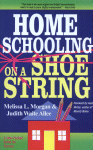 ABOUT
THIS BOOK, Homeschooling
on a Shorstring: A Jam-packed Guide, by
Melissa
L. Morgan
and
Judith
Waite Allee
ABOUT
THIS BOOK, Homeschooling
on a Shorstring: A Jam-packed Guide, by
Melissa
L. Morgan
and
Judith
Waite Allee
This
book is a compendium of ideas for the family that wants to start or
continue homeschooling on a tight budget. You’ll find it all
here:
• Ideas for making money while staying at home.
•
Sources for an inexpensive curriculum.
• Thousands of ideas
for affordable teaching tools.
• Hundreds of suggestions for
low-cost field trips.
• Ways to save on everything from
housing to utilities.
• Ways to get free or low-cost
computers.
Homeschooling
on a Shoestring:
"This
book is the most original and helpful homeschooling book I've read in
years. Highly Recommended."--Mary
Pride, publisher of Practical Homeschooling magazine
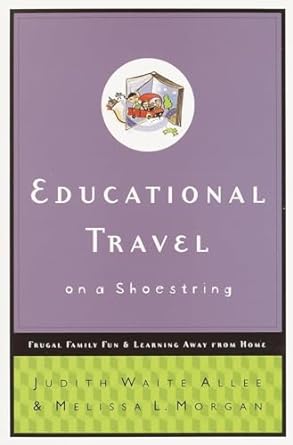
Do
you love to travel, but funds are short? Do you and your family
yearn to learn on the road?
Check
out our book,
Educational
Travel on a Shoestring: Frugal Family Fun and Learning Away from
Home,
, by
Judith
Waite Allee & Melissa
L. Morgan
Practical,
frugal, witty and wise, Educational
Travel On a Shoestring
is
one of those rare books folks will not only delight in reading but
delight in using...Don't leave home without it."
-
-George
Grant, author of Just
Visiting
Enjoy
a
short sample from Educational
Travel on a Shoestring,
with
freebies,
links, and tips from two frugal moms who love to travel. If you find
them helpful, please SHARE with travel and education-minded folks.
When you do, please include the entire letter: Free
Tips for Educational Travel on a Shoestring.
"As
a man thinks in his heart so is he." Proverbs 23:7
Return to EaglesNestHome.com:
A Home For Wise Family, Education and Homeschool Stewardship
Christian
Book Distributors offers a huge
selection of bargain-priced homeschool and educational resources and
books. Portions of
your purchases help support this web site. Thank you!

Copyright
1997-2020 Melissa L. Morgan